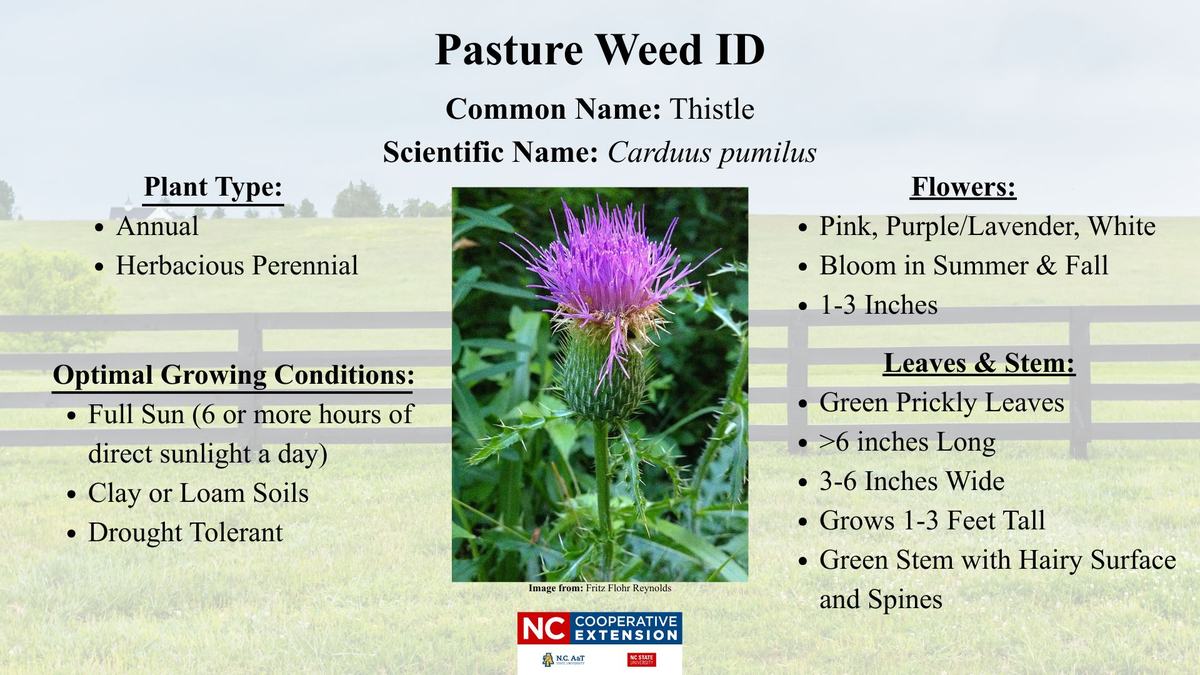
Pasture Weed ID
Thistle
For many producers, thistle is more than just an eyesore — it’s a persistent pasture problem that seems to show up exactly where you don’t want it. Whether it’s scattered plants along fence lines or patches taking hold in grazing areas, thistle often thrives in compacted, overgrazed, or disturbed soils. Its presence can be a sign that pasture conditions need attention, and once established, it spreads easily by wind, livestock, wildlife, and even equipment.
Understanding why thistle grows and how it spreads is the first step toward managing it effectively. Left unchecked, it can compete with desirable forage and reduce pasture productivity. The good news is that there are several practical management options available. This article will explore how thistle develops under certain conditions and outline control strategies using mechanical, biological, and chemical methods to help producers take a proactive approach to keeping pastures productive.
Optimal Conditions:
- Thrive in compacted, disturbed, or low-fertility soils.
- Strong taproots capable of penetrating hard, dense ground; breaks-up compaction and improve soil structure over time.
Spread By:
- Seeds are distributed by wind, animals and equipment.
- It can become invasive very quickly if left untreated.
Treatment Options:
- Mechanical (Physical)-
- Digging- You can dig the plant and root up completely. This plant has a taproot system on it making it easier to dig up and ensures you get the whole root system at once.
- Tilling/Cultivating- As mentioned earlier this plant thrives on compacted soils. Tilling/cultivating will help to break the root system up and help with soil compaction.
- Biological-
- Depending on the type of thistle you have depends on which beneficial insect you can look at using.
- Chemical-
- There are many different chemicals out there to help you control Thistle. When spraying make sure to read the label, the label is the law! Some labels have animal withdrawals from grazing or slaughter.
- Some examples of chemicals you could use would be 2, 4-D, chemicals containing aminopyralid, dicamba, metsulfuron.